
ODD-1 Hardware Granular Synth: Microsonic Sound Lab
The Oddment Audio ODD-1 introduces a new dimension to desktop granular synthesis, positioning itself as a comprehensive sound creation laboratory. This innovative hardware device is built around a unique microsonic processing engine, optimized for a powerful quad-core, 64-bit ARM chip. Consequently, it supports concurrent granular processing for up to eight stereo samples at 48 kHz. Users can add significant depth and movement to their sounds through per-grain spatial audio rendering and ear-inspired filtering, which provides a three-dimensional quality to the output. The ODD-1 is designed for versatility, functioning not only as a multi-timbral synthesizer but also as an expressive sampler, a multi-track looper, and a real-time effects processor. It features two fully independent layers, effectively providing two granular engines in one unit. This architecture allows for diverse setups and concurrent sound exploration. Furthermore, its intuitive and limitless patching system encourages experimentation from the outset. In addition, the device incorporates essential sound sculpting tools such as resonant filters, distortion, bit crush, compression, delay, reverb, LFOs, envelopes, and macro controls. Performance-oriented patch banks are also included, enabling seamless transitions between sounds and functionalities during live sessions.
Intuitive Control and Connectivity
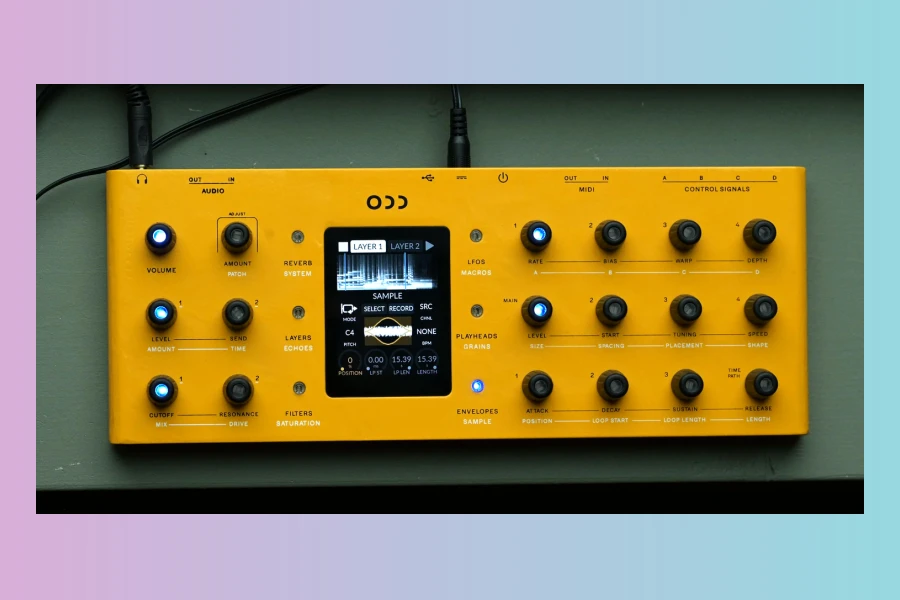
Controlling the ODD-1 is designed to be highly tactile and intuitive. It boasts 18 infinite encoders with integrated switches and LEDs, providing a knob-per-function experience within a travel-friendly form factor. This design offers extensive depth without requiring constant menu diving. Additionally, a 2.8-inch capacitive touch screen enhances interaction with thoughtfully designed visuals, displaying sound visualizations, grain synthesis processes, and modulation plots. This combination ensures that auxiliary parameters are always just a touch away, streamlining the workflow. Connectivity is another strong suit of the ODD-1. It includes four control signal inputs, allowing seamless integration with modular gear, expression pedals, and sustain pedals. Moreover, the device is MPE capable, facilitating highly expressive control over its parameters. For sample management, it provides 4GB of user storage and includes a 2GB library of custom samples created by artists like Joshua Van Tassel and Lee Clarke. Users can capture new stereo samples directly via analog input, microphone input, or USB audio input. Transferring samples and patches, as well as performing firmware upgrades, is simplified by connecting the ODD-1 as a USB drive.
Advanced Sound Processing and Design
The sound processing capabilities are extensive. Dual stereo filters per-voice, offering classic resonant filter designs, can be arranged in series or parallel. Saturation, with distortion, bit crush, and compression, is available per-voice and per-layer. Two echo units per-layer feature distortion and filtering in the feedback loop, ranging from crisp digital delays to warm, evolving feedback. Users can design custom effects by modulating synthesis, filtering, and delay elements, achieving chorus, phasor, flanger, tremolo, and tape emulation. The custom sample analysis further enables unique pitch and timing control modes, while the ability to capture audio directly on the device makes recording performances straightforward. The ODD-1 comes in a durable, powder-coated aluminum enclosure, and a companion ODD-1V plug-in with identical sound processing is planned for times when the hardware isn’t available.

Price
Regular: 999.00 USD
Features
- Custom microsonic (granular) processing engine optimized for quad-core ARM A72 CPUs.
- Per-grain spatial audio rendering and ear-inspired filtering for three-dimensional sound.
- Two fully independent layers capable of multi-timbral synth, sampler, looper, or effects processing.
- Limitless patching system with 4 LFOs, 3 Envelopes, 4 Macros, 4 Control signals, and MIDI control.
- 18 infinite encoders with integrated switches and LEDs for a hands-on, knob-per-function workflow.
- 2.8” capacitive touch screen with vivid sound visualizations and intuitive auxiliary parameter access.
- 8 simultaneous stereo samples (up to 60s at 48kHz) and 8-voice polyphony.
- 4 independent playheads per layer with flexible sample assignment.
- Variable-speed Time Path for infinite sound stretching without losing articulation.
- MPE capable for expressive control and 4 control signal inputs for modular integration.
- Dual stereo filters per-voice (LP, HP, BP, BR) configurable in series or parallel.
- Saturation per-voice and per-layer with distortion, bit crush, and compression.
- Two echo units per-layer with distortion and filtering in the feedback loop.
- 2GB factory sample library and 4GB user storage for samples and patches.
- Capture new stereo samples from analog, microphone, or USB audio input.
- USB-C audio in/out and MIDI in/out, MIDI 2.0 compatible.
- Durable powder-coated aluminum enclosure.
- Companion ODD-1V plug-in with identical sound processing and factory library.
👍 Pros
- ✓ Unique microsonic processing engine with per-grain spatial audio.
- ✓ Highly versatile as a multi-timbral synth, sampler, looper, and effects processor.
- ✓ Intuitive hands-on interface with 18 encoders and a vivid touch screen, plus limitless patching.
👎 Cons
- ✗ The price point of $999 may be a significant investment for some users.
- ✗ Pre-orders have an expected ship date in August 2026, requiring a considerable waiting period.
More info: Oddment Audio | ODD-1