

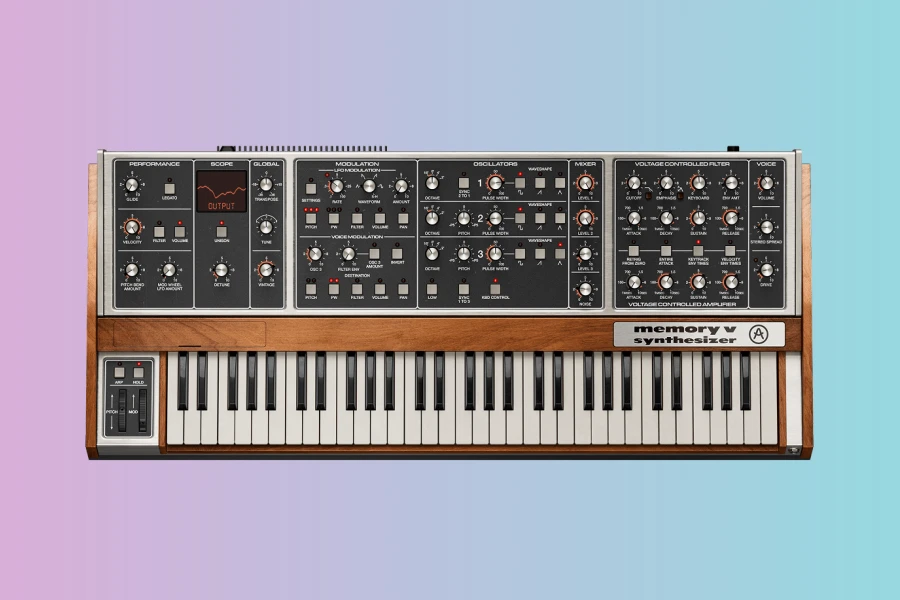
Arturia has recently unveiled Memory V, a new software instrument that meticulously models the classic 1982 Memorymoog polyphonic synthesizer. This release is a significant addition for producers seeking the rich, expansive sound of a vintage analog polysynth within a modern digital workflow. The instrument promises to deliver the characteristic warmth and depth associated with its hardware inspiration. Arturia’s dedication to detail ensures a faithful recreation.
Core Technology and Emulation
Memory V leverages Arturia’s acclaimed TAE (True Analog Emulation) technology. Consequently, it faithfully replicates the original hardware’s distinctive architecture, including its three-oscillator-per-voice design, the iconic ladder filter, and the subtle yet crucial analog non-linearities that contribute to its character. Moreover, the instrument introduces contemporary features such as MPE support, a multi-layer arpeggiator, and a versatile 4-slot effects rack, bridging vintage sound with modern functionality. This blend of classic and contemporary elements makes Memory V a powerful tool for diverse electronic music genres.
Voice Architecture and Polyphony
The instrument offers flexible polyphony, operating in either Poly 6 mode, which matches the original hardware’s voice count, or an expanded Poly 12 mode for even greater sonic breadth. Furthermore, its Unison feature allows users to stack up to six triple-VCO voices, complete with adjustable detune and stereo spread. This configuration can produce a maximum of 18 oscillators from a single key press, resulting in incredibly thick and powerful sounds. In addition, Vintage and Dispersion controls are included to introduce continuous analog drift across various parameters, such as pitch, pulse width, and filter cutoff, adding to its authentic analog feel.
Oscillators and Filter Section
Each voice within Memory V is equipped with three free-running oscillators. These oscillators offer Ramp, Triangle, and Square waveforms, alongside oscillator sync capabilities between OSC 1 and 2, and OSC 1 and 3. Pulse-width control is also available. Notably, OSC 3 can function as an audio-rate modulator, routing to pitch, pulse width, filter, volume, or pan per voice. This allows for complex FM-style movements when chained with the Filter Envelope. The 24 dB/oct low-pass ladder filter is a core component, featuring a switchable 12 dB mode, keyboard tracking, and self-oscillation. A Bass Compensation switch helps maintain low-end presence at high resonance settings. A Drive section with a clipping LED feeds the signal into the filter pre-stage, offering additional tonal shaping.
Advanced Features and Effects
The Advanced panel significantly expands Memory V’s capabilities. It includes a Multi-Arp with four independent, stacked arpeggiator layers, enabling the creation of polymetric and transposed patterns. Three modulator slots—comprising Envelope, Function, Random, Voice Mod, and Mod Sequencer—offer drag-and-drop routing for intricate sound design. Keyboard and Macro modulators further enhance control. Additionally, a 4-slot FX rack provides access to over 17 effects, allowing for extensive sound sculpting. Oscilloscope views for Output, LFO, and Voice Mod signals offer visual feedback during sound creation.
Specifications and Availability
Features
- 300+ factory presets
- MPE and MTS-ESP microtuning support
- NKS and Arturia controller integration
- Resizable interface
- Formats: Standalone, VST3, AU, AAX (64-bit DAWs)
- System Requirements: Windows 10+ or macOS 11+; ARM not supported on Windows
Price
Memory V is currently available at an introductory price until June 14, 2026. Specific pricing details can be found on the Arturia website. It is also included as part of V Collection 11 Pro.
👍 Pros
- ✓ Authentic Memorymoog emulation with TAE technology
- ✓ Modern enhancements like MPE, Multi-Arp, and FX rack
- ✓ Flexible voice architecture with Poly 6/12 modes and powerful Unison
👎 Cons
- ✗ ARM not supported on Windows
- ✗ Requires 64-bit DAWs and specific OS versions
More info: Arturia | Memory V
🛍️ Available at our partners
We may earn a commission from these links.Disclosure: This article contains affiliate links. If you purchase through these links, Noizefield may earn a small commission at no extra cost to you. This helps support our independent journalism.
HIT OR SHIT Indicator
💩
Indication by Noizefield
Average Indication by Readers
🚀
What do you think?
Hit or Shit? Please rate from 1 (💩) to 10 (🚀)
✅ You already voted. Thanks!
Check these out!