

GitHub’s Hidden Audio Gems: 5 Open-Source Projects Revolutionizing Home Studios
Introduction
While commercial audio plugins and hardware dominate the marketing space, a quiet revolution is happening in the repositories of GitHub. Developers, researchers, and passionate musicians are building incredibly sophisticated audio tools—and giving them away for free.
These aren’t half-abandoned hobby projects. Many are the result of academic research, industry collaboration, or years of dedicated open-source development. They offer capabilities that rival or even surpass commercial alternatives, often with the added benefits of transparency, customization, and community support.
Let’s explore five standout open-source audio projects that are genuinely changing what’s possible in home and project studios. Each solves a real problem for electronic music producers and sound designers, and each is available to download, use, and modify today—no subscription, no iLok, no demo limitations.
1. Polymath: Turn Your Music Library into an Intelligent Sample Library
GitHub Stars: ~1,600 | Language: Python | Last Update: Active
The Problem
You’ve spent years collecting music—vinyl rips, digital purchases, field recordings. You know there are amazing sounds hidden in those tracks, but manually sampling, sorting, and tagging them is incredibly time-consuming.
The Solution
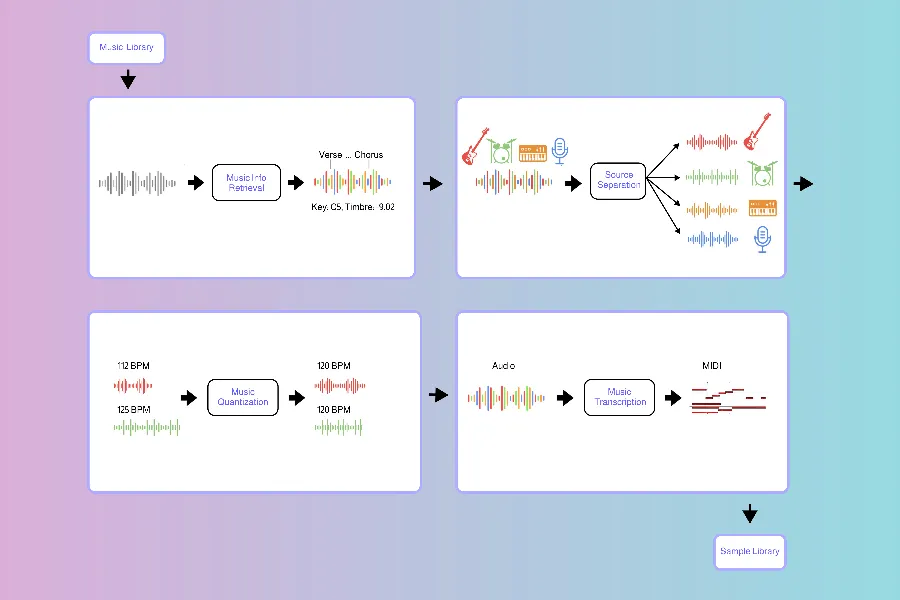
Polymath uses machine learning to automatically analyze your entire music library and convert it into a searchable, intelligent sample library.
How It Works
- Point it at your music folder (supports MP3, WAV, FLAC, etc.)
- It analyzes each track using audio ML models to separate stems, detect key/tempo, and classify sound types (kick, snare, etc.).
- Builds a searchable database where you can find sounds by similarity, instrument type, or even by humming a rhythm.
Practical Studio Use Cases
- Sample library audit: Run it on your “unsorted downloads” folder to discover what you actually have.
- Genre research: Analyze reference tracks to understand common sonic characteristics.
- Sample pack creation: Process your own recordings into a polished, tagged library.
# Clone and install
git clone https://github.com/samim23/polymath.git
cd polymath
pip install -r requirements.txt
Process your music library

python polymath.py
More info here: Polymath at GitHub
2. openDAW: The Browser-Based Digital Audio Workstation
GitHub Stars: ~1,200 | Language: JavaScript/TypeScript, WebAssembly | Last Update: Very Active
The Problem
DAW projects are often tied to specific computers. Sharing sessions requires exporting stems or dealing with incompatible plugin formats.
The Solution
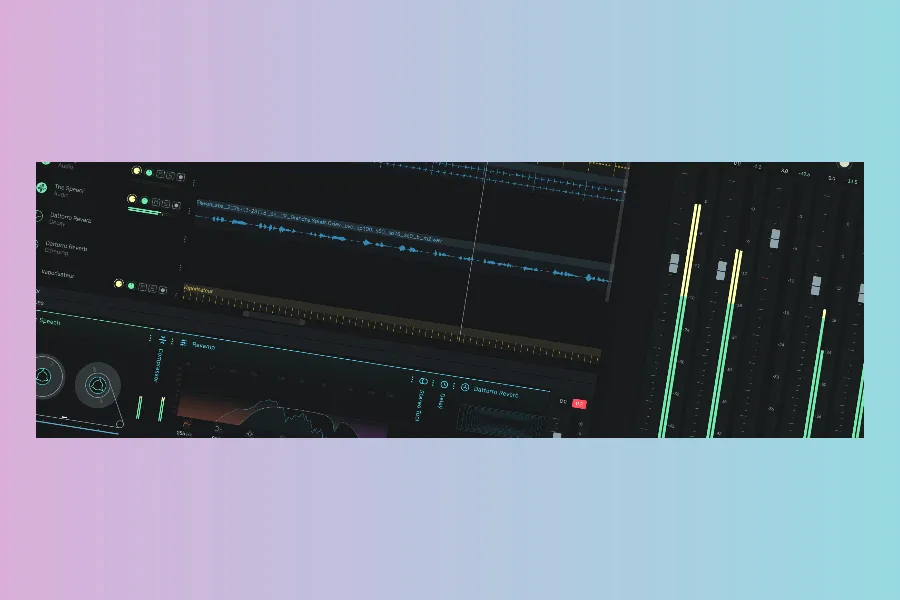
openDAW is a full-featured Digital Audio Workstation that runs entirely in your web browser, using cutting-edge web technologies like WebAssembly for low latency.
Core Features
- Multitrack recording and playback
- MIDI sequencing with piano roll and drum grid editors.
- Real-time collaboration: Multiple users can edit the same session simultaneously.
- No installation: Works on any computer with a modern browser.
Practical Studio Use Cases
- Remote collaboration: Write tracks with bandmates in real-time across the world.
- Reference and review: Share a link for client feedback directly on the timeline.
- Education: Perfect for teaching audio concepts without requiring software installs.
More info here: openDAW at GitHub
3. Spleeter: Stem Separation Made Accessible
GitHub Stars: ~18,000 | Language: Python/TensorFlow | Last Update: Well-Maintained
The Problem
Isolating vocals or drums from a finished track used to be nearly impossible or required extremely expensive software.
The Solution
Spleeter is Deezer’s open-source source separation library that uses neural networks to split audio into 2, 4, or 5 stems (vocals, drums, bass, piano, and other) with high quality.
Why It’s Revolutionary
- Democratizes stem separation: Brings professional-grade isolation to everyone for free.
- Batch processing: Separate hundreds of files automatically via the command line.
- Creative effects: Process separated stems differently (e.g., distortion on just the bass).
# Separate a song into 4 stems
spleeter separate -i audio.mp3 -p spleeter:4stems -o output/
More info here: Spleeter at GitHub
4. Essentia: Audio Analysis and Music Description

GitHub Stars: ~3,500 | Language: C++ | Last Update: Very Active
The Problem
Building tools that “understand” music—like detecting the energy of a track or its danceability—is incredibly complex to code from scratch.
The Solution
Essentia is an industrial-strength library for audio analysis. It implements hundreds of algorithms for rhythm, tonality, and mood detection.
Practical Studio Use Cases
- Automatic DJ mixing: Analyze folders for BPM and key to find harmonic matches.
- Intelligent organization: Sort your library by “brightness” or “danceability.”
- Audio QA: Automatically detect clipping or silence in thousands of files.
More info here: Essentia at GitHub
5. DDSP: Differentiable Digital Signal Processing
GitHub Stars: ~4,500 | Language: Python/TensorFlow | Last Update: Active
The Problem
Standard AI audio generation often lacks the “tweakability” of a real synthesizer. You get a waveform, but you can’t easily turn a knob to change the filter.
The Solution
DDSP, from Google’s Magenta team, combines classic synthesis (oscillators, filters) with neural networks. It allows the AI to learn how to play a “virtual” synth.
Practical Studio Use Cases
- Timbre transfer: Make a recorded violin sound like a flute while keeping the original performance nuances.
- Neural instruments: Train the system on your own voice to create a playable synth that sounds like you.
- Interpretability: Unlike other AI, you can actually see and adjust the parameters the AI is using.
More info here: DDSP at GitHub
Bonus: Honorable Mentions
- Demucs: Often considered the gold standard for high-quality stem separation.
- Pedalboard: Spotify’s library for using VST effects inside Python scripts.
- Sonic Pi: A live-coding environment for creating music with code.
Conclusion
The studio of the future is being built in the open. These tools provide professional-grade power without the gatekeeping of high price tags or restrictive licenses. Whether you want to organize your samples with AI or collaborate in a browser, the resources are waiting for you on GitHub.
HIT OR SHIT Indicator
💩
Indication by Noizefield
Average Indication by Readers
🚀
What do you think?
Hit or Shit? Please rate from 1 (💩) to 10 (🚀)
✅ You already voted. Thanks!
Check these out!