

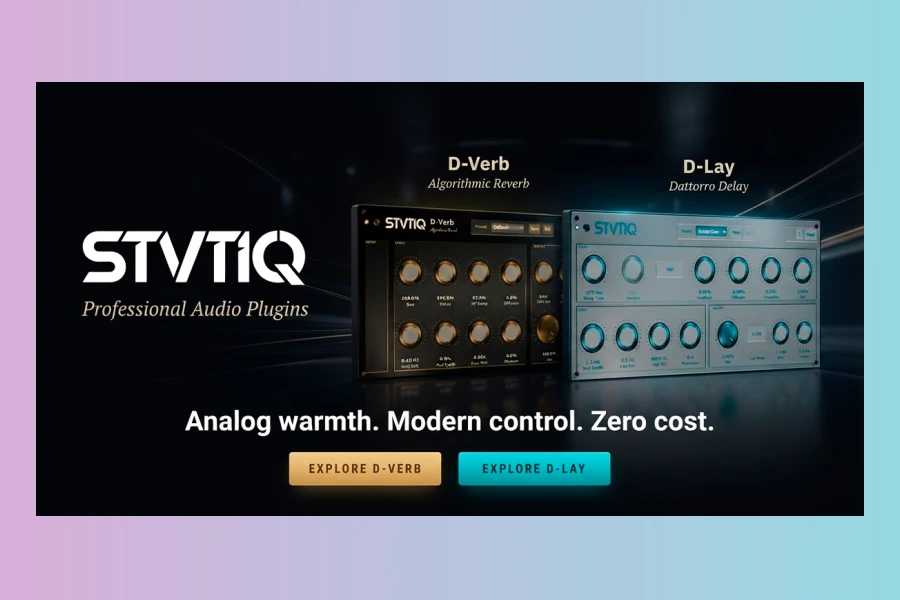
Independent developer STVTIQ has released two new free plugins for music producers. D-Verb and D-Lay are both based on the Dattorro topology, a design known for its dense and lively reverberation. The plugins are available in VST3 and AU formats, covering Windows and macOS systems.
D-Verb: Algorithmic Reverb with Depth
D-Verb is a stereo algorithmic reverb that creates a wide range of spaces, from compact rooms to expansive ambient soundscapes. It uses twelve independent early reflection taps and four input diffusers. Furthermore, the signal runs through two cross-coupled decay tanks, producing a rich and modulated tail. You can shape the sound with controls for pre-delay, size, decay, damping, and diffusion. Additionally, D-Verb includes a bass sustain parameter, an octave-up shimmer, and adjustable modulation rate and depth. A built-in ducking circuit with release control helps clear space in a mix. The wet signal width is adjustable, and a dry/wet mix control allows parallel processing. The interface is organized into Input, Space, and Output sections, making navigation intuitive.
Features
- Independent twelve-tap early reflections
- Four input diffusers and two cross-coupled decay tanks
- Pre-delay and input filtering
- Size, decay, high-frequency damping, and diffusion controls
- Adjustable modulation rate and depth
- Bass sustain control
- Octave-up shimmer
- Wet-signal stereo width
- Built-in ducking with adjustable release
- Dry/wet mix control
- Factory and user presets
- Host automation and project-state recall
- Resizable user interface
- 32-bit floating-point audio processing
- 2x oversampled diffuse reverb stage
D-Lay: Diffuse Stereo Delay with Tape Coloration
D-Lay is a tempo-aware stereo delay that transforms repeats into part of the sound. Its delay time ranges from 10 to 1000 ms and can be synced to your DAW via host tempo or tap tempo. You can choose from 14 note divisions, including straight, dotted, and triplet values. The delay uses a cross-coupled diffusion tank, which adds density and stereo movement to each repeat. Therefore, D-Lay can behave like a rhythmic delay, a character echo, or even an ambient effect approaching reverb-like textures. The feedback path includes soft saturation and adjustable tape hiss. Internal modulation with rate and depth controls brings motion to the echoes. Two dedicated filters (low-cut and high-cut) shape the wet signal, with adjustable resonance. A GLIDE mode produces pitch-shifting transitions during delay-time changes. Alternatively, CLEAN mode offers dual-head crossfading for smoother repeats. Dedicated wow and flutter controls emulate tape instability. A dry/wet mix control completes the plugin.
Features
- Free delay time from 10 to 1000 ms
- Tap tempo
- Host-tempo synchronization
- 14 straight, dotted, and triplet note divisions
- Cross-coupled diffusion tank
- Adjustable feedback and diffusion
- Soft saturation in the feedback path
- Adjustable tape hiss
- Internal modulation with rate and depth controls
- Wet-signal low-cut and high-cut filters
- Adjustable filter resonance
- GLIDE mode for pitch-moving delay-time changes
- CLEAN mode with dual-head crossfading
- Dedicated wow and flutter controls
- Dry/wet mix control
- Factory and user presets
- Host automation and project-state recall
- Resizable user interface
- 32-bit floating-point audio processing
Availability and Future Plans
STVTIQ offers both plugins as freeware, with no limitations or cut-down editions. They are available for Windows (VST3) and macOS (AU). The user interface is resizable and supports high-resolution displays. All parameters can be automated in any modern DAW. In addition, each plugin includes factory presets and the ability to save user presets. The developer plans to expand the collection with more effects and utilities. Voluntary support is accepted via Boosty or cryptocurrency. Both D-Verb and D-Lay are now available for download. Therefore, if you are looking for creative reverb and delay effects without spending money, these plugins are definitely worth trying.
👍 Pros
- ✓ Free and full-featured
- ✓ Classic Dattorro-based sound
- ✓ Extensive controls and presets
👎 Cons
- ✗ No AAX version
- ✗ No Linux support
More info: STVTIQ | D-Verb and D-Lay
HIT OR SHIT Indicator
💩
Indication by Noizefield
Average Indication by Readers
🚀
What do you think?
Hit or Shit? Please rate from 1 (💩) to 10 (🚀)
✅ You already voted. Thanks!
Check these out!