

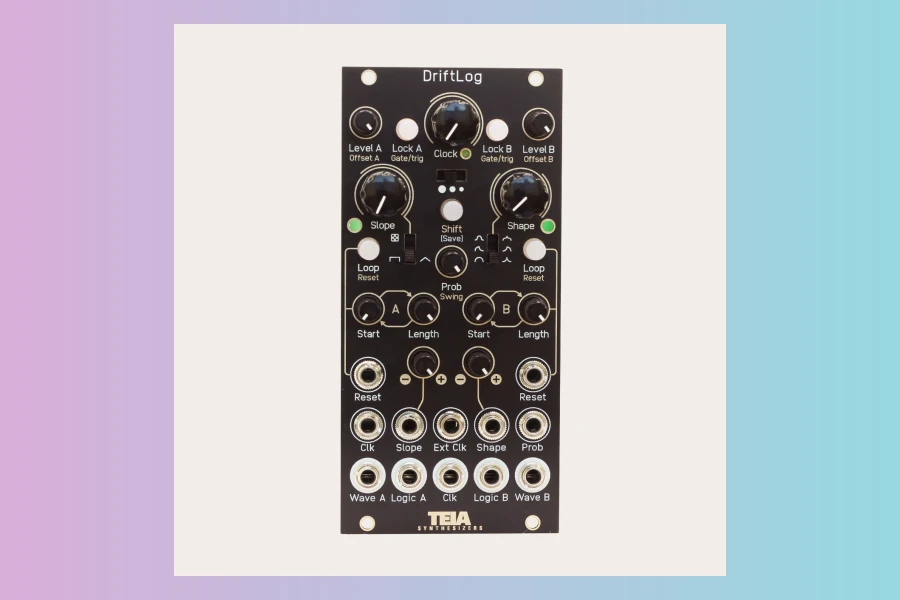
Teia Synthesizers has introduced DriftLog, a new dual-channel cycling random voltage generator designed to bring controlled, loopable randomness to Eurorack systems. Modulation is a fundamental aspect of electronic music production, particularly within the modular synthesizer ecosystem, where dynamic voltage control can transform static sounds into evolving soundscapes. DriftLog aims to address the limitations of traditional random sources by offering a highly flexible and repeatable modulation solution within a compact 12HP footprint.
This innovative module generates, captures, and reshapes random voltages in real time, effectively transforming unpredictable randomness into a playable and repeatable modulation source. The design prioritizes both precision and creative control, ensuring that users can harness the power of chance without sacrificing musicality. Moreover, its dual-channel architecture allows for complex, independent modulation streams, enhancing its versatility within any modular setup.
Advanced Voltage Generation and Shaping
Both channels of the DriftLog module generate independent random voltages, boasting a 16-bit resolution and a +5/-5V range. This high fidelity ensures smooth and precise control over various parameters. Furthermore, users can select between stepped and smooth random voltage generation, with continuous interpolation providing seamless transitions. The module features a Slope control, which morphs the output from classic stepped random voltages to continuous glides between successive values. Similarly, the Shape control allows for detailed sculpting of these glides, offering options from linear transitions to more complex Bezier, exponential, and peak-based curves. Consequently, producers can achieve a wide array of modulation textures, from abrupt changes to organic, flowing movements.
A shared clock dictates the rate at which new values are generated, while a Prob control introduces conditional variation, determining whether changes occur on a given clock step. This feature significantly enhances the module’s ability to create evolving, yet structured, random sequences. In addition, individual Lock buttons enable each channel to retain its current Slope, Shape, and Prob settings independently. This capability makes it possible to establish contrasting motion behaviors between both channels, even when using the same global controls.
Loopable Randomness for Repeatable Patterns
A standout feature of the DriftLog is its ability to continuously record recent random values. This functionality allows each channel to be switched into a Loop mode, enabling the replay of a selectable portion of this recorded history. Dedicated Start and Length controls define the loop range and can be adjusted live during playback. Therefore, free-running randomness can be reshaped into repeatable modulation patterns, all while preserving an organic variation that prevents excessive predictability. This unique approach bridges the gap between pure randomness and structured musical composition, offering new avenues for sonic exploration.
Comprehensive Features and Connectivity
The module includes a Shift button, which provides access to a secondary control layer. Alternate functions, such as DC Offset, Swing, Manual Reset, and Gate/Trigger selection, are clearly labeled in gold directly on the panel. Holding Shift for three seconds saves the current settings, which are automatically recalled on power-up, ensuring that preferred configurations are always readily available. Moreover, DriftLog offers CV modulation for its Clock, Slope, Shape, and Probability parameters, providing extensive external control possibilities. An internal clock with selectable rate ranges is also included, alongside automatic external clock synchronization. Furthermore, per-channel logic outputs, configurable as either gates or triggers, are available, as is a clock output that follows the active timing source.
Features
- Dual random voltage generator (16 bit resolution, +5/-5v range)
- Stepped and smooth random voltage generation with continuous interpolation
- Shapeable voltage transitions with Bezier, exponential, and peak-based curves
- Probability control for conditional value generation
- Loop-based capture and replay of random voltage sequences
- Start and Length controls for defining loop range
- Manual and External sequence Reset
- Per-channel level scaling and offset control
- CV modulation for Clock, Slope, Shape, and Probability
- Internal clock with selectable rate ranges
- Automatic external clock synchronization
- Per-channel logic outputs, selectable as gates or triggers
- Clock output following the active timing source
- State save/recall for preserving settings across power cycles

Price
Intro: 285.00 € (ex. VAT)
Regular: 300.00 € (ex. VAT)
Pros
- Dual-channel with 16-bit resolution and flexible voltage shaping options.
- Loop-based capture and replay for controlled, repeatable random sequences.
- Comprehensive CV modulation capabilities and state save/recall functionality.
Cons
- Eurorack specific, requiring an existing modular system.
- Some motion-shaping controls are shared between channels, despite individual lock buttons.
More info: Teia Synthesizers | DriftLog
HIT OR SHIT Indicator
💩
Indication by Noizefield
Average Indication by Readers
🚀
What do you think?
Hit or Shit? Please rate from 1 (💩) to 10 (🚀)
✅ You already voted. Thanks!
Check these out!