

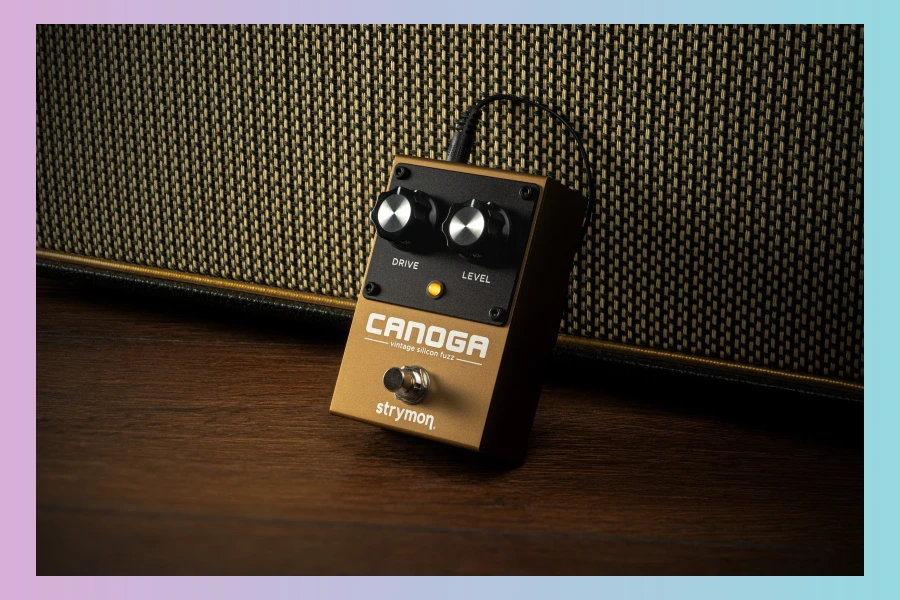
Strymon, a highly respected manufacturer in the realm of effect pedals, has officially unveiled its latest innovation: the Canoga. This sophisticated dual-stage drive pedal is meticulously engineered to provide an expansive range of saturation, effectively transitioning from subtle, transparent overdrive to powerful, high-gain distortion. Importantly, the Canoga expertly combines an analog JFET front end with advanced digital signal processing (DSP). This integration allows it to precisely simulate a wide array of saturation characteristics, thereby offering both the warmth of analog circuitry and the versatility of digital control. This fusion of technologies aims to deliver an unparalleled sonic experience for guitarists and electronic music producers alike.
Core Architecture and Versatility
At the technical core of the Canoga lies its ingenious dual-stage topology. The signal path initiates with a discrete Class A JFET input circuit. Strymon emphasizes that this design not only provides an optimal high-impedance interface for various instruments but also maintains exceptionally low-noise performance. Subsequently, the secondary gain stage leverages Strymon’s proprietary algorithms. These algorithms are specifically developed to accurately emulate the complex clipping behaviors typically associated with classic vacuum tube and diode-based hardware, ultimately contributing to a rich and authentic tonal palette. Consequently, this hybrid approach allows for a remarkable breadth of sonic textures.A standout feature of the Canoga is its continuous gain morphing capability. The dedicated Gain control is far more than a simple level adjustment; it simultaneously modifies multiple crucial parameters. For instance, it dynamically adjusts the clipping threshold, shapes the frequency response, and fine-tunes compression characteristics. This integrated control scheme empowers users to seamlessly transition between various circuit topologies, thereby offering a highly dynamic and expressive driving experience. Furthermore, the selectable Voice Switch significantly expands its versatility. It provides distinct clipping profiles, ranging from a smooth, symmetrical saturation to a more edgy, asymmetrical harmonic content, allowing for diverse sonic exploration.
Tonal Control and Connectivity
Beyond its fundamental drive capabilities, the Canoga provides extensive tools for precise tonal shaping. It incorporates an active 3-band EQ, featuring independent Bass, Middle, and Treble controls. These allow for meticulous post-distortion tonal adjustments, ensuring the pedal can be perfectly tailored to complement various instruments, amplifiers, and musical contexts. Moreover, for those seeking advanced integration within a studio or live setup, the Canoga boasts full MIDI implementation. This includes comprehensive control over all parameters via either 5-pin DIN or USB-C, coupled with the convenience of 300 user-definable preset locations. This level of control makes it a powerful tool for complex setups.Connectivity is another notable strength of the Canoga. It supports full stereo signal paths, facilitated by its TRS input and output jacks. This makes it an ideal choice for modern stereo rigs, keyboard setups, or advanced studio applications where stereo processing is crucial. Furthermore, the unit integrates high-performance 24-bit 96kHz A/D and D/A converters, ensuring pristine audio fidelity throughout the entire signal chain. Users also have the flexibility to choose between a true bypass mode, which guarantees zero signal coloration when the effect is disengaged, or a buffered bypass mode, specifically designed to preserve signal strength and clarity over extended cable runs. All these advanced components are housed within a compact, robust anodized aluminum chassis, built to withstand the demands of both touring musicians and dedicated studio environments, representing a blend of innovation and durability.Features
- Dual-Stage Topology: Combines an analog JFET input stage with a Sharc DSP-powered distortion engine.
- Continuous Gain Morphing: The Gain control adjusts multiple parameters simultaneously, including clipping threshold, frequency response, and compression.
- Active 3-Band EQ: Includes dedicated Bass, Middle, and Treble controls for post-distortion tonal shaping.
- Selectable Voice Switch: Offers different clipping profiles, ranging from symmetrical “smooth” saturation to asymmetrical “edgy” harmonic content.
- Configurable Mono/Stereo: Supports full stereo signal paths via TRS input and output jacks.
- MIDI Implementation: Full MIDI control over all parameters, including 300 preset locations via 5-pin DIN or USB-C.

Price
Regular: 199.00 USD
👍 Pros
- ✓ Versatile tone range from transparent overdrive to high-gain distortion
- ✓ Advanced dual-stage design combining analog JFET and powerful DSP
- ✓ Comprehensive MIDI control with 300 preset locations and stereo capabilities
👎 Cons
- ✗ Hybrid analog/digital architecture might not appeal to purists seeking a fully analog drive
- ✗ Premium price point for a drive pedal, potentially a consideration for some budgets
More info: Strymon | Canoga
HIT OR SHIT Indicator
💩
Indication by Noizefield
Average Indication by Readers
🚀
What do you think?
Hit or Shit? Please rate from 1 (💩) to 10 (🚀)
✅ You already voted. Thanks!
Check these out!