

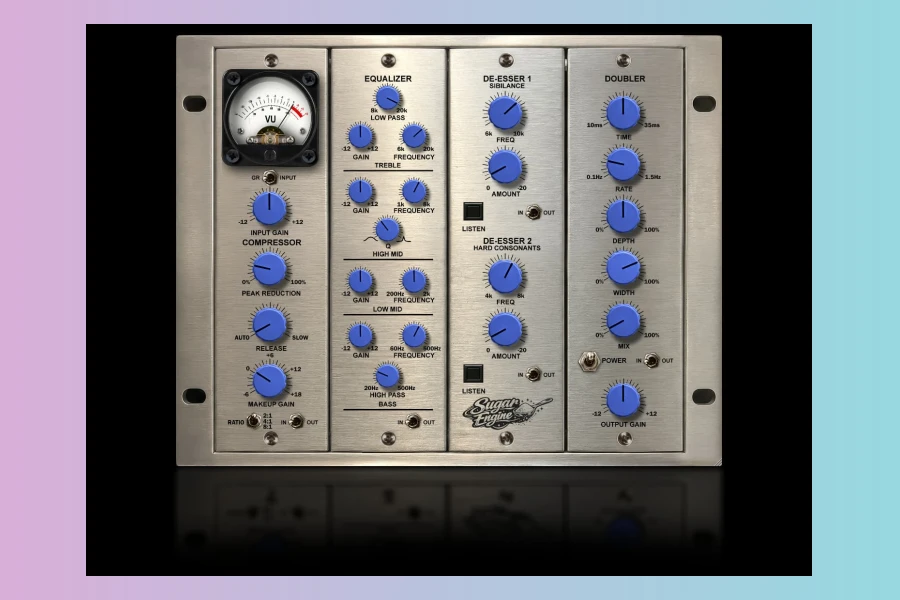
M Media Audio has officially launched Sugar Engine, a new vocal processing plugin designed with a unique fixed signal chain. Unlike modular alternatives, Sugar Engine integrates an opto compressor, a six-band parametric EQ, a dual de-esser, and a stereo doubler in a set order. This design philosophy aims to streamline workflow and ensure consistent processing, making it particularly suitable for both studio environments and live sound applications. Each of the four stages can, however, be independently bypassed, offering flexibility within its structured approach.
Streamlined Compression and Equalization
The plugin’s compressor section employs a two-stage opto gain-reduction model, featuring a photocell release response where the release time adapts to how long the circuit has been engaged. A single Peak Reduction knob efficiently combines both threshold and input drive into one intuitive control. Furthermore, the compression ratio is set to three distinct positions: 2:1, 4:1, and 8:1. For added convenience, an Auto Release function provides program-dependent timing, while a front-panel switch allows users to toggle the VU meter between displaying gain reduction and input level.
Moving to the equalization stage, Sugar Engine offers a versatile six-band EQ. This includes a high-pass filter, two semi-parametric low-mid bands, and a fully parametric mid band with adjustable Q. Additionally, it features a semi-parametric air band and a low-pass filter. Importantly, the EQ utilizes IIR filters throughout its design. This choice deliberately avoids the added latency and pre-ringing often associated with linear-phase filter designs, thus maintaining optimal phase coherence without compromising processing speed.
Advanced Dual-Stage De-essing and Doubling
A standout feature of Sugar Engine is its sophisticated dual-stage de-esser. This section addresses sibilance with a precision often missed by single-band de-essers. De-esser 1 is specifically tuned to target sustained sibilance in the 6-10 kHz range, which is a standard frequency area for de-essing. Conversely, De-esser 2 incorporates a separate, faster detector designed to handle hard consonant transients, such as ‘T’, ‘K’, and ‘CH’ sounds, within the 4-8 kHz range. This faster detection is crucial as these transients arrive and decay much more rapidly. Both de-esser stages include a “Listen” button, allowing users to solo the detection band for accurate threshold setting.
Finally, the stereo doubler effect enhances vocal presence and width. It achieves this by generating a short delay, adjustable between 10-35 ms, combined with a slow chorus modulation ranging from 0.1-1.5 Hz. Crucially, this modulation is applied only to the delayed signal, leaving the dry path unaffected. Controls for Depth and Width (offering 0-100% stereo spread) allow for detailed shaping of the effect, and a Mix knob adjusts the wet/dry blend. It transforms a mono input into a stereo output, further enriching the vocal. The deliberately capped rate range ensures the effect consistently reads as a natural doubling rather than straying into typical chorus territories.
The fixed order and per-stage bypass capabilities make Sugar Engine a practical tool for producers and engineers seeking a reliable and efficient vocal processing solution. Its design ensures that every stage is optimized for its role within a cohesive vocal chain, addressing common mixing challenges with purpose-built tools.
Features
- Fixed four-stage signal chain: opto compressor, six-band parametric EQ, dual de-esser, stereo doubler, each independently bypassable.
- Opto compressor: two-stage gain reduction, photocell release response, combined Peak Reduction (threshold + drive) control.
- Three fixed compression ratios (2:1, 4:1, 8:1) plus program-dependent Auto Release.
- VU meter switchable between gain-reduction and input-level display.
- Six-band EQ: HPF, two semi-parametric low-mid bands, one fully parametric mid band with adjustable Q, semi-parametric air band, LPF.
- IIR filter design throughout the EQ: no linear-phase latency.
- Dual-stage de-esser: sibilance detector (6-10 kHz) and a separate, faster consonant-transient detector (4-8 kHz) for T/K/CH sounds.
- Listen/solo button on each de-esser stage for setting detection thresholds.
- Doubler: 10-35 ms delay with 0.1-1.5 Hz chorus modulation applied only to the delayed signal.
- Doubler Depth, Width (0-100% stereo spread), and Mix controls; mono input, stereo output.
Price
Regular: 49.00 USD
Pros
- Optimized fixed signal chain for comprehensive vocal processing
- Innovative dual-stage de-esser for precise sibilance and transient control
- Latency-free IIR EQ filters for transparent processing
Cons
- Fixed module order limits flexibility for custom signal chain arrangements
- Compression ratios are fixed, offering less granular control than some alternatives
More info: M Media Audio | Sugar Engine
HIT OR SHIT Indicator
💩
Indication by Noizefield
Average Indication by Readers
🚀
What do you think?
Hit or Shit? Please rate from 1 (💩) to 10 (🚀)
✅ You already voted. Thanks!
Check these out!