

That probably tells you more about the instrument than any specification sheet could.

Disclosure: Arturia provided Pure Sub to me before its official release. They did not influence what I say in this review. The opinions and observations here are based on my own testing and use of the instrument.
What Is Arturia Pure Sub?
Pure Sub is a bass-focused synthesizer plugin aimed primarily at electronic music producers.
Its strongest territory is obvious from the first few minutes of use: bass-heavy electronic music, including drum & bass, dubstep, neuro, trap, techno, electro and other styles where the low end is not just part of the mix but an important musical element.
The interesting part, however, is that Pure Sub isn’t simply a synthesizer that generates a sine wave and then throws distortion on top.
The instrument separates the fundamental low-frequency content from the upper harmonic material and gives you extensive control over how those components interact.
That distinction becomes particularly important when designing bass sounds that need to work on both a large club system and smaller playback systems.
A pure sub-bass frequency might sound enormous on a studio subwoofer but practically disappear on a phone, laptop or small speaker. Pure Sub addresses that problem by allowing you to introduce harmonic and textural information above the fundamental.
The result can retain the physical weight of the sub while still giving the listener something audible in the upper frequency range.
First Impressions: This Is Definitely a Bass Instrument
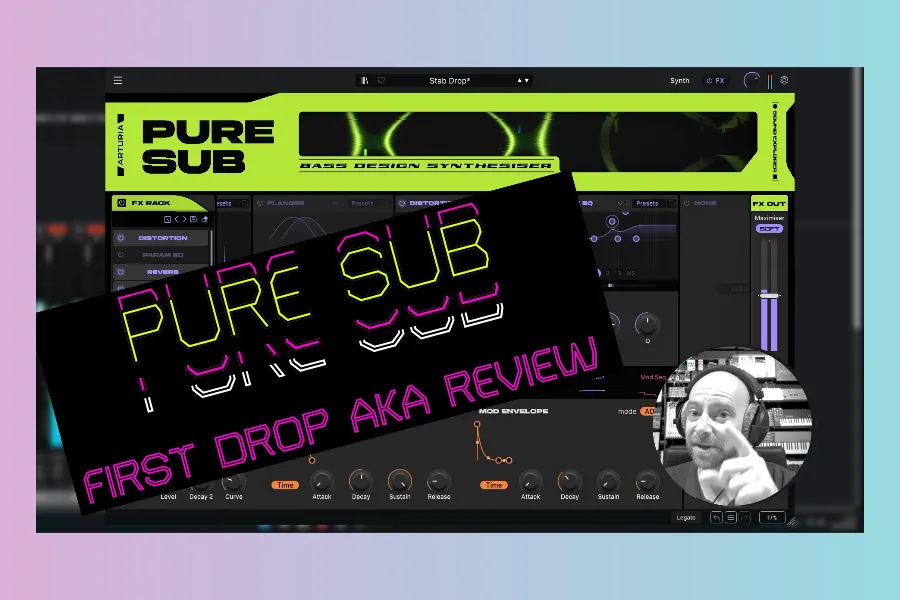
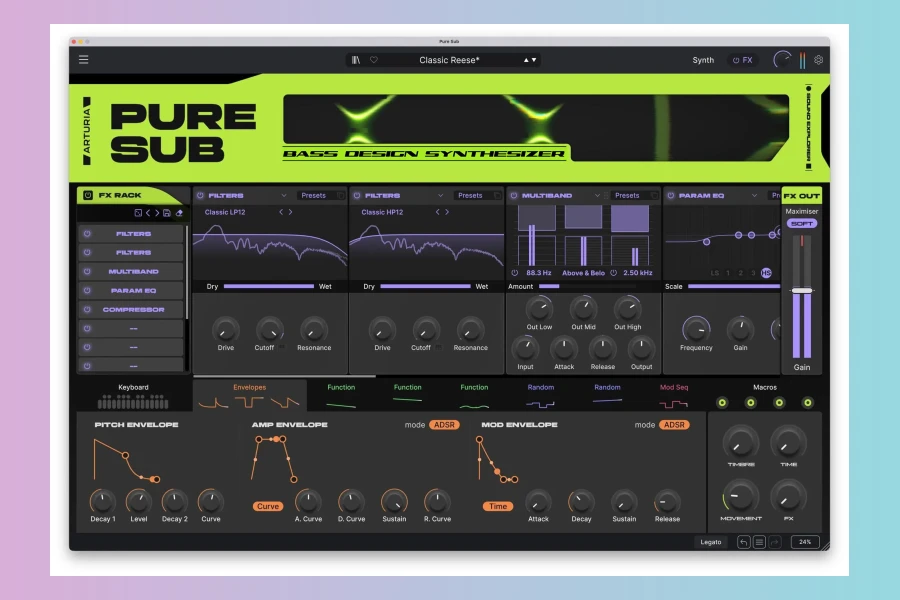
The first thing I noticed about Pure Sub was its visual identity.
The interface has a distinctive yellow/green aesthetic that immediately gives it a somewhat futuristic, almost early-90s electronic-music character. It also feels like an instrument designed for people who are interested in sound design rather than simply playing presets.
“It looks quite drum-and-bass-y, if you ask me… It has these drum & bass and 1990s vibes with this yellow-greenish aesthetic.”
The interface is large. Very large.
“This is so huge. This plugin is so massive… you need so much real estate here that it is almost too large for my screen.”
At its default size, Pure Sub takes up a significant amount of screen real estate. Thankfully, the interface can be resized, which becomes important if you’re working on a laptop.
Once inside the instrument, the architecture becomes considerably more interesting. The main areas include:
- the core synthesis engine
- sub/fundamental control
- harmonic shaping
- texture/noise processing
- filtering
- modulation
- macro controls
- preset browsing
- an extensive effects rack
And that last section deserves special attention.
The Core Sound Engine
The heart of Pure Sub is its bass-generation engine.
One of the most interesting design choices is the separation between the sub/fundamental portion of the sound and the harmonic content above it.
The fundamental provides the physical low end, while the harmonic section can introduce additional frequency information that makes the bass more audible and characterful.
“This is not yet another stupid bass synthesizer… you see that there have been some real thoughts put into it.”
This is particularly useful because you can think about the sound in two dimensions:
- How much actual sub do I want?
- How much information do I want above the sub?
That’s a much more useful way of approaching bass design than simply turning up an oscillator.
Pure Sub also provides controls for manipulating the harmonic structure, including morphing and different tonal configurations.
You can start with something relatively close to a sine-wave-based bass and gradually introduce increasingly complex harmonic content. And the difference can be dramatic.
A relatively simple low-frequency sound can suddenly become much more aggressive, punchy and recognizable once the harmonics are introduced.
Sub-Bass That Survives Smaller Speakers
This is one of the areas where Pure Sub’s concept makes a lot of sense.
If you produce bass-heavy music, you already know the problem. A 30 Hz or 40 Hz fundamental might sound enormous on a good monitoring system, but much of that information simply isn’t reproduced by smaller speakers.
“Usually the bass frequencies are so low that you cannot hear them on small speakers or mobile devices. Adding noise creates a psychoacoustic effect that makes the bass audible.”
That’s where harmonics and texture become useful. By adding controlled higher-frequency information, the listener can perceive the bass even when the actual fundamental isn’t being reproduced properly.
Pure Sub makes this part of the sound-design process unusually accessible. Instead of building the entire system yourself with a synthesizer, saturation, distortion, EQ and several additional plugins, you can work with these concepts directly inside the instrument.
The important point is that this doesn’t mean Pure Sub magically creates sub-bass on every playback system. Physics still wins.
What it can do is give the ear enough harmonic information to perceive the bass more effectively when the fundamental itself is difficult to reproduce.
The Texture Section
Another important part of Pure Sub is its texture processing. This was one of the features I became increasingly interested in during testing.
“This is a good example of how sound design works and what a difference it makes if we add some noise or texture to a more or less clean sound… that makes a huge difference!”
Start with a relatively clean bass sound. Then introduce texture. Suddenly, the sound can become much more audible and much more interesting.
This isn’t necessarily about making the bass louder. It’s about making it more complex. Texture can add:
- high-frequency information
- noise
- grit
- movement
- perceived width
- additional character
- a sense of physical distortion or amplification
The difference between a clean bass and a bass with carefully controlled texture can be enormous. And because Pure Sub is designed specifically around bass, these controls feel like part of the instrument rather than an afterthought.
Filters: One of Pure Sub’s Biggest Strengths
If there is one part of Pure Sub that really impressed me during testing, it is the filter section.
The instrument includes a large selection of filter modes—more than 40 according to the material I was working with during the prerelease testing—and there is considerably more variety here than I initially expected from a bass-focused synthesizer.
There are conventional filtering options, but also more characterful modes that can dramatically transform the sound. And this is where Pure Sub starts becoming much more than a conventional sub-bass generator.
You can use the filters to introduce:
- resonance
- movement
- harmonic emphasis
- aggressive tonal changes
- glitch-like effects
- cinematic textures
- rhythmic movement
- unusual spectral shapes
Some of the filter modes can sound almost like an effect in their own right.
One particularly interesting experiment involved increasing resonance and moving the filter through the frequency spectrum. At certain settings, the fundamental low-end character can disappear and the sound becomes much more focused on the resonant frequency. Move the filter back down and suddenly the huge low-end component returns.
“If we crank the resonance, we can immediately hear that if we are too high in the frequency spectrum, we don’t have the bass anymore… But if we go down, the low end comes roaring back.”
This is exactly the kind of interaction that makes a synthesizer fun to explore.
Modulation: Where Things Get Really Interesting
Pure Sub isn’t just about static bass patches. There is a surprisingly deep modulation system behind the relatively approachable interface.
You have multiple envelopes and modulation sources, including:
- pitch envelope
- amplitude envelope
- modulation envelope
- function-style modulation
- randomization
- step-based modulation
- velocity modulation
- other assignable modulation destinations
The important thing is that the modulation doesn’t feel restricted to one or two obvious destinations. A large number of parameters can be animated. That makes a huge difference when you’re creating modern electronic bass sounds.
For example, you can use modulation to change filter cutoff, harmonic content, texture, drive, pitch, attack, other synthesis parameters, and effects parameters.
This is particularly useful for drum & bass and related styles, where a static bass patch can quickly become boring. The bass itself can become part of the rhythm.
Function Generators and Rhythmic Movement
The function-generation section is another feature that deserves attention. You can create custom curves and use them as modulation sources. This means you aren’t limited to simple LFO shapes.
You can create more complex movements and assign them to parameters within the synth or effects section. The possibilities become particularly interesting when you synchronize these movements to the host tempo.
For sound design, this opens the door to:
- evolving basses
- rhythmic filter movements
- one-shot pitch effects
- changing distortion
- animated harmonics
- stereo movement
- rhythmic effects
Some of these possibilities aren’t immediately obvious when you first open the instrument. That’s part of why Pure Sub rewards exploration.
Velocity and Expressive Control
Pure Sub also works well when you want the keyboard to influence the sound.
During testing, I mapped velocity to parameters such as attack and immediately got a useful response. Playing softly could produce a different character from playing harder.
This is particularly useful if you’re using Pure Sub as an actual musical instrument rather than simply triggering one bass note repeatedly. You can make a patch react to your playing rather than simply playing back the exact same sound every time.
For expressive bass lines, that can be extremely useful.
The Macro Controls
The macro controls are perhaps less technically exciting, but they are extremely practical.
This is especially important because Pure Sub can become quite deep once you start opening up the modulation and synthesis sections. If you don’t want to spend ten minutes adjusting individual parameters, the macros give you a much faster way to reshape a preset.
This makes the workflow something like: Preset → Macro adjustment → Detailed sound design rather than: Preset → 47 parameters → existential crisis.
And I actually think this is one of the reasons the instrument feels relatively approachable despite its depth.
The Effects Rack
Pure Sub includes a substantial effects section, and this is where the instrument can go from relatively conventional bass synth to complete sound-design playground.
The effects rack includes things such as:
- distortion
- bit crushing
- reverb
- delay
- tape-style processing
- EQ
- compression
- flanger
- filters
- multi-band processing
- modulation effects
- additional coloration effects
The exact combination and routing possibilities depend on the patch, but the overall idea is clear: You don’t necessarily need to leave Pure Sub to finish the sound.
And that is important. A bass patch often needs considerably more processing than a normal synthesizer sound.
You might traditionally end up doing something like: Synth → EQ → distortion → saturation → multiband distortion → filter → compressor → reverb/delay → additional EQ.
Pure Sub brings a significant amount of that workflow into the instrument.

The Effects Can Get Completely Out of Control
And I mean that positively.
Pure Sub’s effects section can be extremely subtle, or you can completely destroy the sound. A bit crusher can turn an otherwise clean bass into something aggressive and digital. Distortion can add serious upper harmonics. The filters can become rhythmic effects. Reverb can push the sound into cinematic territory. Multi-band processing can produce the familiar aggressive, moving character associated with neuro-style bass design.
You can also cascade effects. That means the effects section itself becomes a sound-design environment.
The downside is obvious: It is very easy to overdo it. I frequently found myself pushing an effect too far simply because it was fun. For production, restraint will often be necessary. For sound design, however, that’s exactly what makes this section entertaining.
One Thing I Would Change About the Effects Routing
There was one thing I repeatedly found myself wanting: I would have preferred a more explicit way to maintain a completely clean sub signal while processing the upper-frequency material independently.
“Honestly, I would prefer to have less effects slots, but to parallelize them so that we can have a dry signal chain and an affected signal chain… so we can go completely overboard on the upper end without ruining the sub.”
In other words, I’d love a workflow where you could have clean sub untouched while simultaneously sending harmonics through distortion, filters, or bit crushers.
That would be particularly useful for modern bass production because keeping the actual sub controlled while aggressively processing the upper bass is a very common technique.
Pure Sub already provides tools that move in this direction, but I found myself wanting even more explicit parallel routing. It’s not necessarily a deal-breaker, but it’s the main area where I wanted more control during my testing.

Presets: A Major Part of the Experience
Pure Sub comes with a substantial preset library. During my testing I was seeing around 251 presets in the browser after removing some filters, along with various categories and styles.
The browser allows you to narrow things down by characteristics and musical styles. That’s important because the instrument covers quite a broad range of bass sounds despite its focused concept.
You can find sounds suitable for:
- drum & bass
- dubstep
- trap
- techno
- electro
- breakbeat
- footwork
- future bass
- IDM
- cinematic material
- atmospheric sounds
- rave-inspired sounds
- other electronic styles
There are also different sound characteristics such as punchy, warm, thin, atmospheric, complex, funky, aggressive, and sustained.
That makes the browser much more useful than simply having hundreds of unnamed bass patches.
The Presets Are Not All Traditional Bass Sounds
This was something I appreciated. Some presets are obviously designed to be usable bass sounds, while others are essentially sound-design material that can function almost like kicks, impacts, cinematic effects, transitions, rhythmic textures, atmospheric layers, and distorted bass effects.
This makes Pure Sub considerably more versatile than the name might suggest. You can absolutely use it for conventional bass lines, but you can also use it as a sound-design instrument.
Pure Sub Can Also Make Kicks
One of the more interesting discoveries during my testing was how effectively Pure Sub can move into kick-drum territory.
“This is almost a kick drum… I like that you can play it like a bass instrument, combining kick and bass comping into one, leading to very interesting melodic vibes.”
The combination of fundamental frequency, harmonics, pitch envelope, amplitude envelope, transient characteristics, texture, filtering, and effects gives you enough control to create convincing electronic kick sounds.
A very basic kick can start with something close to a sine wave and a pitch envelope. Add harmonics and suddenly the sound becomes much more aggressive. Add processing and you can push it toward something suitable for harder electronic music.
This is particularly interesting because the instrument isn’t limited to making “bass notes.” You can create sounds that occupy the boundary between kick and bass. That is an important area in modern electronic production.
Randomization: Fun, But With a Caveat
Pure Sub has several randomization functions. These are excellent for quickly generating variations.
However, there is an important distinction: The randomization isn’t necessarily equivalent to completely randomizing every parameter of the synthesizer. In several places, the system is effectively working with preset or component variations.
That’s actually understandable. Completely randomizing every parameter of a sophisticated bass synth could easily result in total chaos. Still, I found myself wishing for an additional true parameter randomizer—something like: “I don’t care if this makes something completely ridiculous. Randomize everything.”
That would be fantastic for experimental sound design. Perhaps that’s something that could be expanded in a future version.
Sound Design Without the Presets
Although I spent a lot of time browsing presets, Pure Sub becomes considerably more interesting when you start building your own sounds.
The fundamental/harmonic approach gives you a useful conceptual structure. You can start with a basic sound and then work through:
Fundamental → Harmonics → Texture → Filter → Modulation → Effects → Macros
Product image – audio product image
That workflow is relatively easy to understand. And importantly, you don’t need to understand every single feature before you can make something useful. That’s a major strength.
“Overall, it has a lot of depth, but it’s not super complex—and I mean this in a very, very positive way… I got the core idea within an hour.”
Some synthesizers give you enormous amounts of control but require you to understand their architecture before you can accomplish anything. Pure Sub feels more immediate. You can start turning knobs and getting meaningful results almost immediately.
How Does Pure Sub Sound?
Ultimately, this is the most important question.
It sounds good. More importantly, it has a recognizable character. The low end can be extremely deep, while the harmonic and texture sections allow you to make that low end audible and aggressive.
“This is fucking deep… The low end has a lot of pressure, and that’s what I really like.”
With the right presets and processing, it can produce enormous sub bass, punchy bass, Reese-style sounds, distorted neuro bass, dubstep bass, trap bass, aggressive electronic bass, cinematic low-end effects, kick/bass hybrids, and atmospheric low-frequency textures.
And the filters are particularly useful for pushing the sounds beyond conventional bass synthesis. I also found that some of the more extreme processing could produce surprisingly cinematic and glitchy results.
Pure Sub in a Real Production
The second day of testing was actually more revealing than the first.
On the first day, I spent a lot of time exploring the synthesizer. On the second day, I decided to put myself under a time constraint and actually make music: 20 minutes. Make something.
Of course, I immediately broke my own rules. Instead of making music, I started exploring Pure Sub again. This is worth mentioning because it demonstrates both the strength and weakness of an instrument like this. There is enough depth to spend hours sound designing instead of producing.
But eventually I started putting it into an actual project. I experimented with a drum-and-bass-inspired arrangement around 140 BPM, tried different bass presets, adjusted envelopes and effects, and layered multiple instances.
And this is where Pure Sub started to make more sense to me. It is not just a “bass preset machine.” It is a production instrument. You can find a sound, adjust it quickly, put it into an arrangement, duplicate the instance, choose another patch and continue building.
Pure Sub Is Particularly Strong for Bass Music
After using it in an actual project, I think its strongest audience is fairly obvious. If you produce:
- Drum & Bass: Pure Sub makes a lot of sense. The combination of sub control, harmonics, filters, modulation and effects is almost tailor-made for the genre.
- Dubstep: Again, obvious. The distortion, movement, harmonic processing and modulation can take sounds into very aggressive territory.
- Neurofunk: This is probably one of the most obvious use cases. The ability to create complex modulation and process the upper harmonics heavily while maintaining a strong fundamental gives you plenty of material for neuro-style bass design.
- Trap: The instrument can produce the enormous, sustained and distorted low end that works well in trap and related styles.
- Techno: Don’t overlook it. Pure Sub isn’t limited to modern bass music. The more restrained sounds can work perfectly well for techno and electro, particularly when used rhythmically.
- Cinematic Sound Design: This was a pleasant surprise. Some of the deeper resonant and heavily processed sounds immediately reminded me of cinematic impacts and horror/sci-fi sound design. If you have a large monitoring system, some of these sounds are genuinely physical.
CPU Usage
During my testing, Pure Sub was not the lightest plugin running on my system. On my M5 MacBook Air, I was seeing roughly 10–20% CPU usage depending on what I was doing.
That’s not necessarily a problem. Modern synthesizers can be computationally expensive, particularly when they combine synthesis, modulation, filters and multiple effects. And considering how much processing Pure Sub is capable of doing internally, the CPU usage didn’t strike me as unreasonable.
Still, if you’re running dozens of instances in a large project, it’s something to keep in mind. Freezing or bouncing tracks may become useful in particularly heavy sessions.
The Interface: Deep, But Not Overwhelming
One thing I came to appreciate after spending more time with Pure Sub is that it manages to provide considerable depth without feeling like an aircraft cockpit.
There are plenty of advanced functions hidden behind the main controls, but the basic workflow remains understandable. The main signal flow makes sense:
Sub → Harmonics → Texture → Filter → Modulation → Effects
You can go deeper when you want to. You can also ignore much of it when you don’t. That’s a good design decision.
The macro controls reinforce this philosophy. You can treat Pure Sub as a relatively simple bass instrument—or you can spend an entire afternoon exploring its deeper sound-design capabilities. Both approaches work.
What I Like About Arturia Pure Sub
- It has a clear purpose: Pure Sub isn’t trying to be everything. It is a bass instrument. That focus makes the whole design more coherent.
- The low-end architecture makes sense: Separating the fundamental/sub component from the harmonic information is a practical approach to modern bass production.
- The filters are excellent: The filter section is one of the most enjoyable parts of the instrument. There is enough variety to go far beyond conventional subtractive synthesis.
- The modulation system is powerful: There is plenty of room for movement and automation. This is essential for contemporary electronic bass design.
- The effects are extensive: You can get very far without leaving the plugin.
- The presets are genuinely useful: There is a good mixture of production-ready sounds and more experimental sound-design material.
- It’s fun: This sounds trivial, but it isn’t. A synthesizer that makes you want to keep experimenting is a good synthesizer.
What I Don’t Like
- The effects can dominate the sound: Some presets rely heavily on processing. That can sound impressive immediately, but sometimes it makes it difficult to understand what the underlying synthesis engine is actually doing. Thankfully, the effects section can be bypassed.
- I wanted more explicit parallel processing: As mentioned earlier, I would love a clearer way to keep the true sub completely clean while heavily processing the upper material.
- The randomization could go further: Preset/component randomization is useful, but a genuine “randomize all parameters” option would be a fantastic addition.
- It can encourage endless tweaking: This is simultaneously a strength and a weakness. You can easily spend hours making sounds without actually finishing your track. I know this because I did exactly that.
Is Arturia Pure Sub Easy to Learn?
Yes—but with an important qualification.
You can understand the basic concept very quickly. The deeper modulation and routing possibilities take longer. You don’t need to understand everything to get useful results. That’s probably one of the best things about the instrument.
During my testing, I was already making useful sounds relatively early in the process. After several hours, however, I was still discovering new ways of combining modulation, filters and effects.
So I’d describe the learning curve as: Easy to start. Deep enough to keep you busy.
That’s exactly what I want from a modern synthesizer.
Who Should Buy Pure Sub?
I would strongly consider Pure Sub if you are an electronic music producer working regularly with bass-heavy material. It’s particularly compelling for producers working in drum & bass, neurofunk, dubstep, trap, techno, electro, breakbeat, IDM, experimental electronic music, and cinematic sound design.
It’s also useful if you already own a lot of synthesizers but find yourself constantly building bass patches using several plugins.
Pure Sub’s advantage is its specialization. Instead of starting with a general-purpose synth and then assembling a complicated processing chain, you can start with an instrument whose entire architecture is designed around the problem.
Who Probably Doesn’t Need It?
If you mainly produce acoustic music, pop, singer-songwriter material or styles where bass is relatively straightforward, Pure Sub probably isn’t going to revolutionize your workflow.
And if you already have a bass synthesizer that you absolutely love and rarely need anything else, you may not need another one.
Pure Sub isn’t valuable simply because it can generate a bass note. Pretty much every synthesizer can do that. Its value comes from the combination of focused bass synthesis, harmonic control, texture, filtering, modulation and integrated effects.
Final Verdict
After two long sessions with Arturia Pure Sub, my initial skepticism largely disappeared.
At first, I wasn’t completely convinced. Some of the factory presets felt heavily processed, and I initially wondered whether Pure Sub was simply another synthesizer designed to make extremely polished dubstep sounds.
It isn’t.

Once I started turning off the effects, examining the underlying engine, experimenting with the harmonics and building sounds myself, the instrument started to make much more sense. There is real depth here.
The combination of a dedicated sub section, harmonic control, texture processing, a large filter collection, extensive modulation and a serious effects rack makes Pure Sub much more interesting than its relatively simple concept might suggest.
And then there is the most important test: I actually wanted to keep using it.
“Every once in a while, a new instrument comes along that makes you want to open your DAW and start experimenting again. Pure Sub is one of those instruments.”
I sat down intending to review it. Instead, I ended up making sounds. Then I made a track. Then I went back into the synthesizer. Then I lost another hour.
That’s generally a good sign.
Pure Sub has a very clear identity. It doesn’t try to replace every synthesizer in your collection. It focuses on bass—and within that area, it provides an impressive amount of depth.
If you’re producing bass-heavy electronic music, I think Pure Sub deserves a serious look. It has plenty of sub. It has plenty of harmonics. It has filters for days. It has modulation. It has effects. And, perhaps most importantly, it gives you enough possibilities to come up with sounds that can push you into a slightly different creative direction.
That’s something I value more and more with software instruments.
Arturia Pure Sub Review: A Deep Dive Into Arturia’s Bass Synthesizer
-
Overall Sound Quality
-
Sound-design potential
-
Modulation
-
Effects
-
Preset library
-
Workflow
-
CPU efficiency
Summary
Arturia Pure Sub is a focused, deep and highly playable bass synthesizer that goes considerably further than simply generating sub frequencies. Its combination of fundamental control, harmonics, texture, filters, modulation and effects makes it particularly compelling for electronic music producers who want serious low-end sound-design capabilities without building every processing chain from scratch.
4.6
User Rating
( votes)
Comments Rating
0
(0 reviews)
HIT OR SHIT Indicator
💩
Indication by Noizefield
Average Indication by Readers
🚀
What do you think?
Hit or Shit? Please rate from 1 (💩) to 10 (🚀)
✅ You already voted. Thanks!
Check these out!


Leave a Reply
You must be logged in to post a comment.